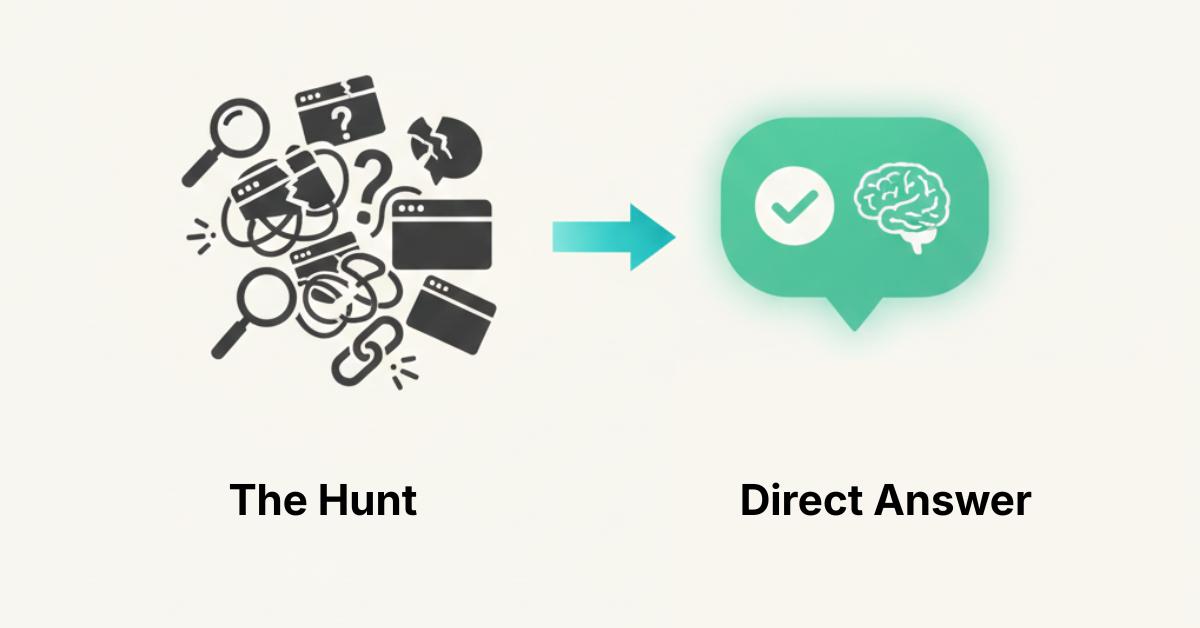
Your Customers Aren't "Searching" Anymore. They're Asking.
The search engine as you know it is dead. Or, at the very least, profoundly reshaped. For nearly three decades now, finding the perfect product or service meant embarking on "the hunt", that familiar, often frustrating, ritual of endless clicking, comparing, and verifying. That era, defined by Google's groundbreaking launch in 1998, is abruptly over. Today's customer doesn't want a list of links to investigate. They want a single, trusted, "direct answer." This isn't just a tweak; it's the biggest shift in consumer discovery in a generation, and businesses unprepared for it are already becoming invisible.
A customer needed something specific, say for example an ergonomic office chair for bad back pain, with a €400 budget, delivered to Galway in three days without a surprise customs bill. Up to now, they would type a few keywords into Google, and then the work began. They’d open ten tabs. They’d squint at shipping policies to decode post-Brexit rules. They’d scan Google or Trustpilot reviews to see if "next-day delivery" was a promise or a lie. They were investigators, logistics managers, and procurement officers all at once.
The new generation of AI-powered search engines from ChatGPT to Google’s AI Overviews has fundamentally changed consumer behavior. Today's customer doesn't want a list of links to investigate; they want a single, verified solution that matches their precise criteria. They are asking complex, conversational questions and expecting the AI to do the heavy lifting of vetting, filtering, and recommending.
This is a catastrophic shift for unprepared businesses that are still optimizing for the "old world" of clicks and keywords.
From "The Hunt" to "The Answer": The Customer Journey Reimagined
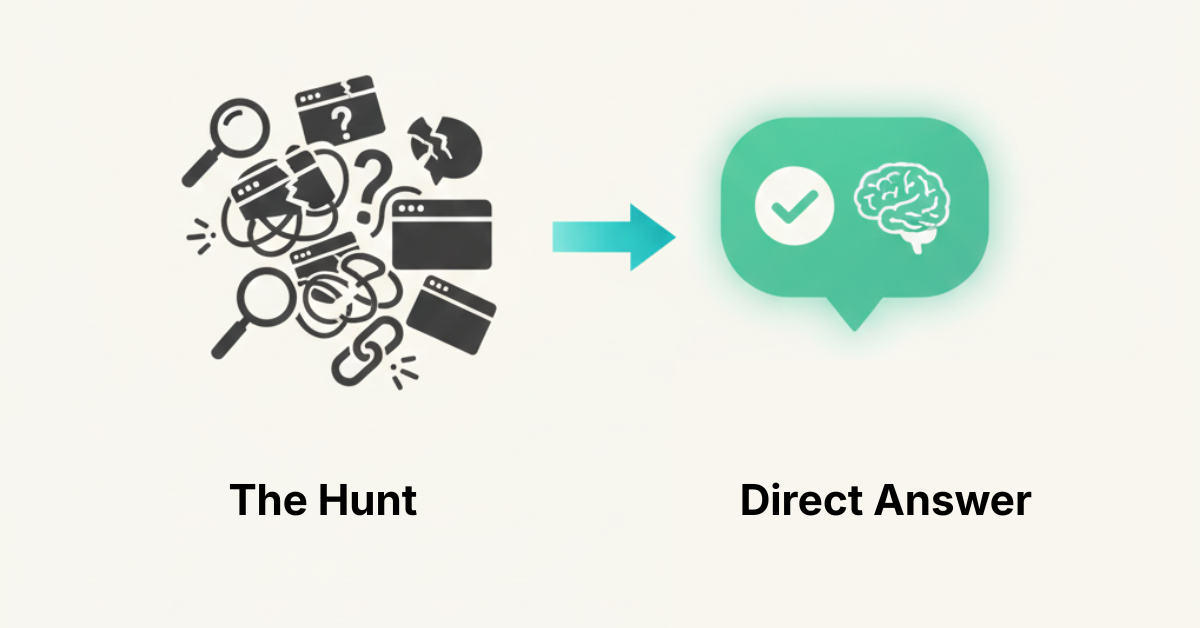
Let’s summarise the monumental shift in how customers find what they need:
The Old Customer Journey (Pre-AI Search)
- The Problem: The customer has a need.
- The Action: Types keywords into a search engine.
- The Result: Receives a list of blue links (SERP).
- The Effort: Clicks multiple links, navigates different websites, filters information, verifies trustworthiness, compares options. This is a research project.
- The Decision: Eventually makes an informed (or exhausted) choice.
- Business Focus: SEO for clicks, display ads, keyword stuffing, content volume.
The New Customer Journey (With AI Search):
- The Problem: The customer has a need, often complex and nuanced.
- The Action: Asks a conversational question to an AI search engine (e.g., "Find me X for Y reason, with Z budget, delivering to A by B, from a trusted source").
- The Result: Receives a concise, vetted, direct answer or a curated shortlist of highly relevant options.
- The Effort: Minimal. The AI has done the research, filtering, and trust verification. This is an instant solution.
- The Decision: Chooses from a pre-vetted answer, often with immediate confidence.
- Business Focus: Optimising for AI understanding, structured data, comprehensive digital footprint, robust trust signals, clear value proposition.

Sarah's Chair: A Real-World Example of the AI Advantage
Let's revisit Sarah, based in Galway, desperately needing an ergonomic office chair for her bad back. She has a strict budget of €400 and needs it delivered within three days, crucially, without any unexpected customs duties or Brexit-related delays.
The Old Way for Sarah:
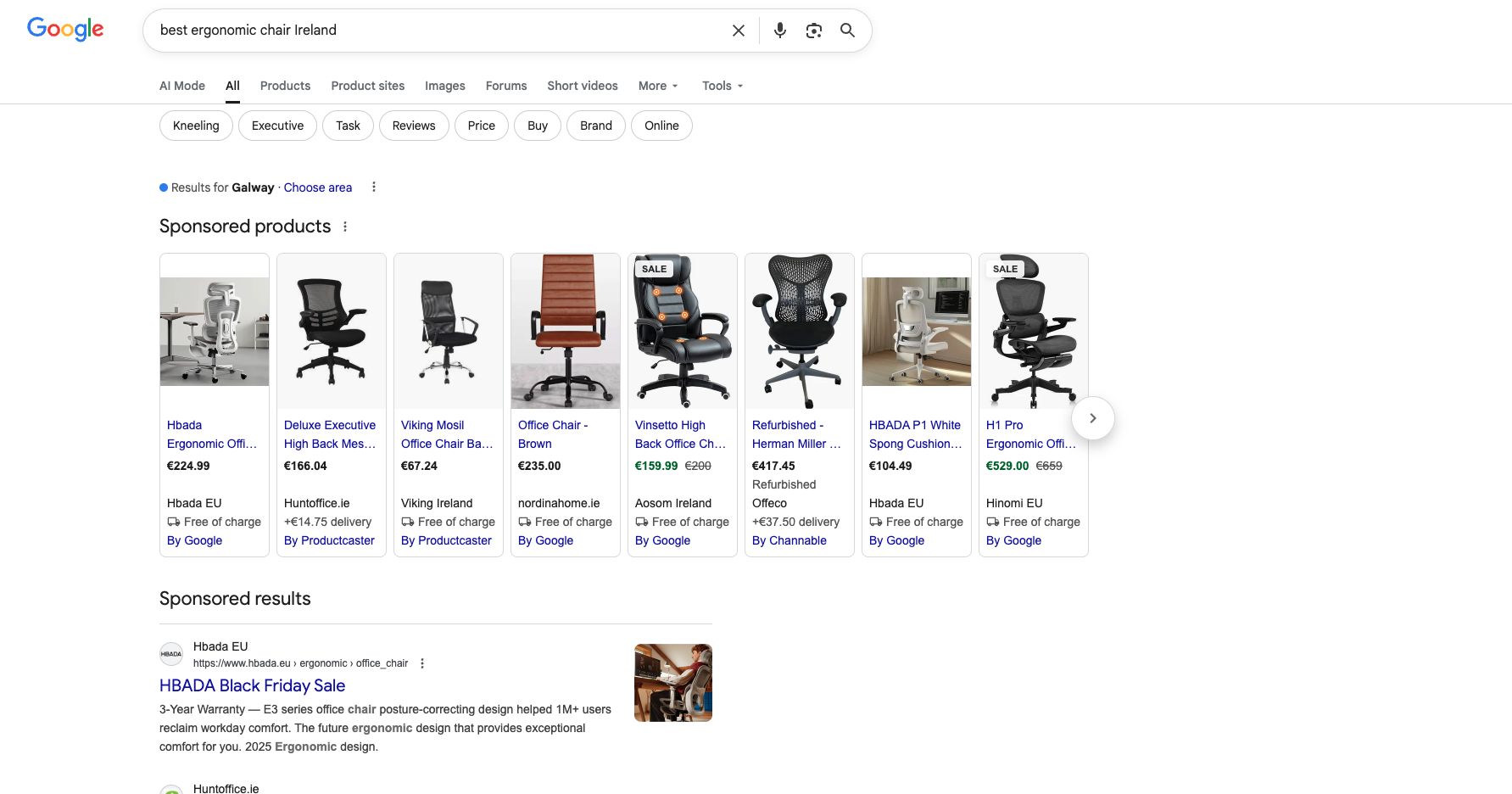
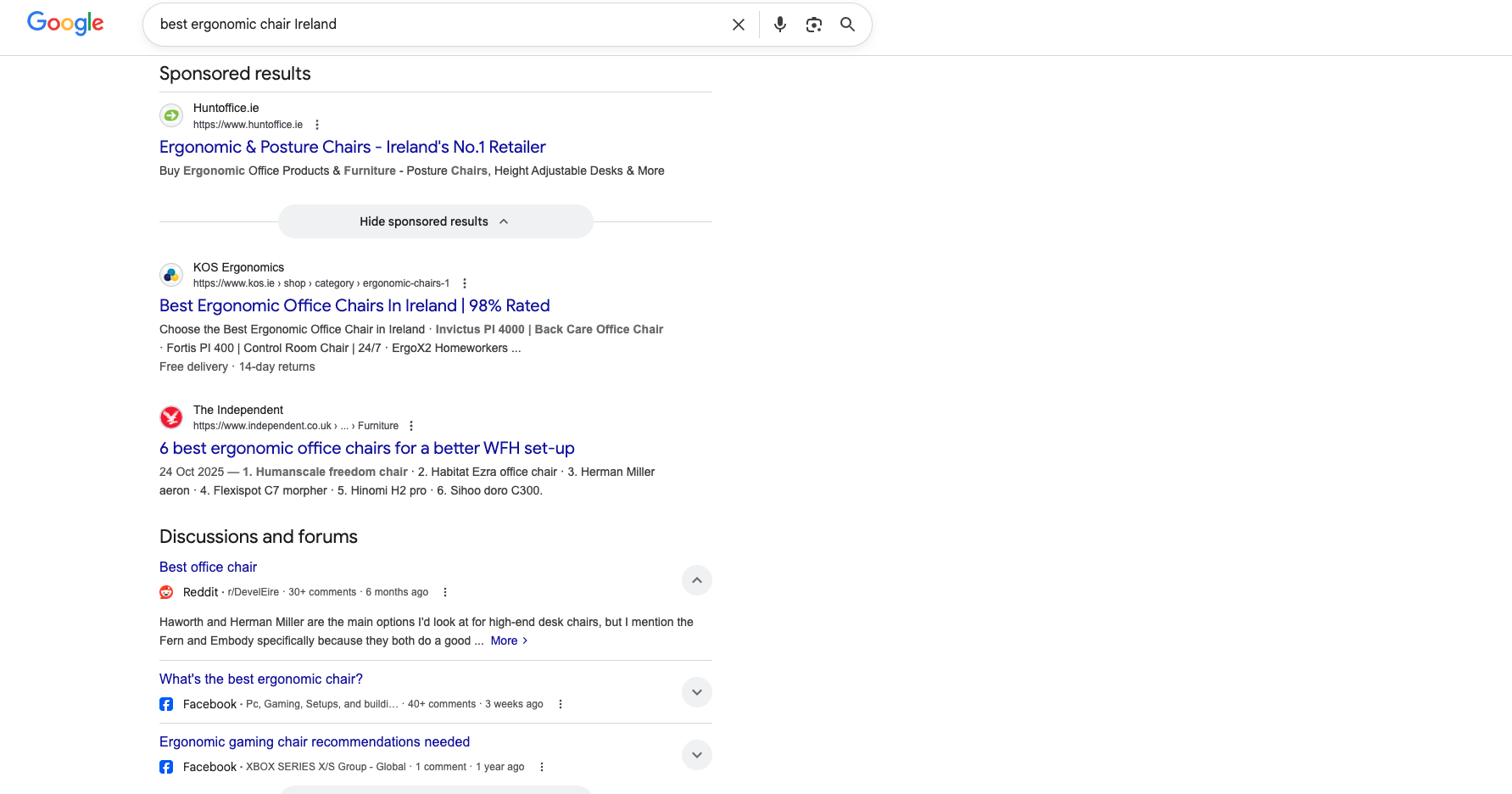
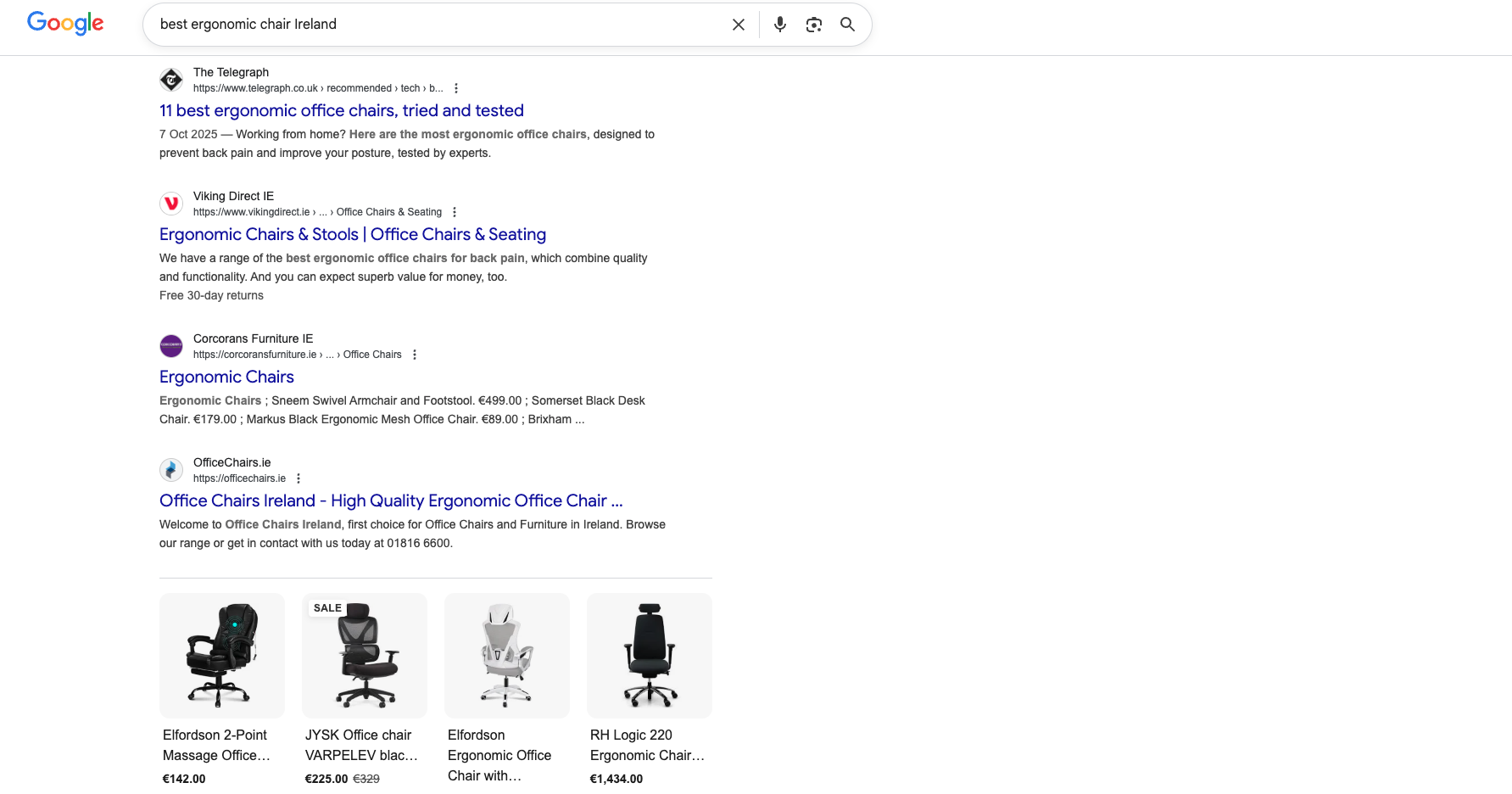
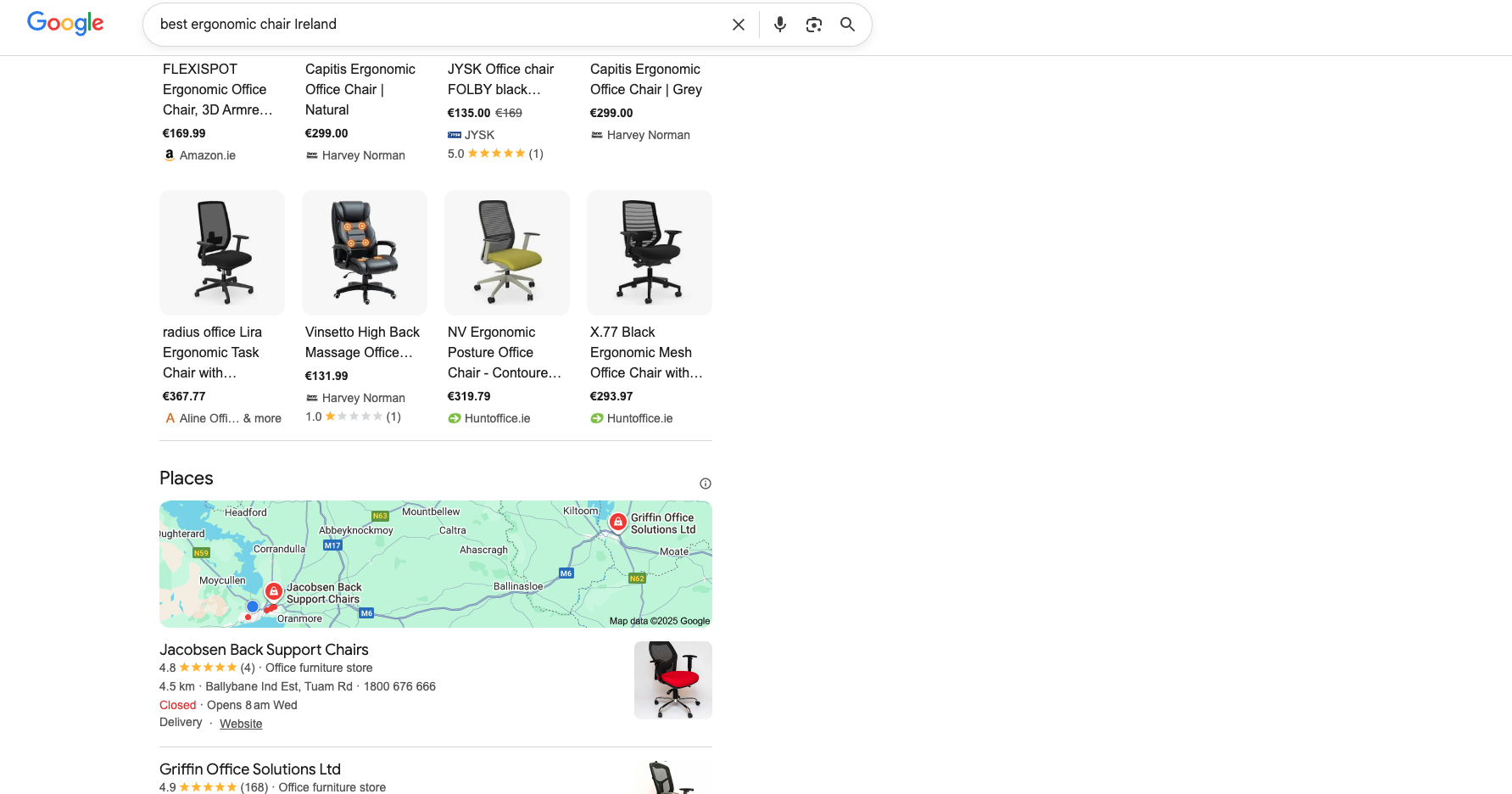
She'd type "best ergonomic chair Ireland" into Google. She’d be bombarded with sponsored ads, google shop products from a variety of retailers she’s never heard of, irrelevant UK retailers with hidden costs, generic "Top 10" listicles from years ago, and numerous rabbit holes that required manual verification of shipping policies, return processes, and genuine customer reviews across different platforms. This process could easily consume hours, leading to frustration and decision fatigue.
The New Way for Sarah (with AI Search):
Sarah phrases her need conversationally: "Find me a highly-rated ergonomic office chair under €400 that delivers to Galway within 3 days, duty-free. Avoid UK sellers unless they explicitly cover customs."
The AI, leveraging its vast knowledge base and sophisticated algorithms, doesn't just show her a list of links. It presents her with an answer:
"The [Your Business Name Here] offers the ErgoSupport 3000 for €389. They are an Irish-based company in Dublin, provide guaranteed 2-day delivery to Galway via DPD, and have a 4.9-star rating on Trustpilot specifically for their swift and transparent delivery process to ROI customers."
The Key Difference: The AI did the vetting. It filtered for budget, precise location, logistics (the crucial "duty-free" and delivery speed trust signals), and specific product need. Sarah no longer has to click, sift, and verify. She gets a trusted solution almost instantly.
 The Wake-Up Call: Is Your Business Ready to Be the Answer?
If Sarah isn't clicking links anymore, how do you ensure the AI recommends your business as the "answer"? This question should send shivers down the spine of every business owner. The data is stark: a recent study indicated that 92% of small businesses are unprepared for this AI search paradigm shift, and even 48% of large businesses are lagging.
This isn't just about SEO anymore; it's about Ai Search or as some in the industry classify as GEO – Generative Engine Optimization and AEO – Answer Engine Optimization. It's about optimizing for machines to understand you perfectly.
Here are the critical questions every business owner must ask themselves today:

1. Technical Fundamentals: Is Your Data Machine-Readable?
- Structured Data (Schema Markup): Are you using Schema.org markup to explicitly tell AI models about your products, prices, availability, shipping regions, delivery times, return policies, and unique selling propositions? This isn't just for product pages; think about events, services, local business information.
- Semantic Understanding: Does your website content move beyond basic keywords to truly answer the "who, what, why, where, when, how" of your offerings in natural language?
- Website Speed & Mobile Responsiveness: AI prioritizes user experience. Is your site fast and perfectly optimised for all devices?

2. Digital Footprint & Brand Authority: Are You an "Entity"?
- Comprehensive Online Presence: Is your business information consistent and accurate across all platforms – Google Business Profile, industry directories, social media, review sites, and your own website? Inconsistent data points are red flags for AI.
- Trusted Citations: Are reputable industry sites, local news outlets, or influential blogs citing your business as an authority or expert in your field? AI models assess authority based on how often and by whom you are referenced.
- "About Us" & Expertise: Is your brand story clear? Do you clearly articulate your expertise, values, and what makes you unique? AI seeks to understand entities, not just websites.
3. Signals of Trust & Transparency: Are You Verifiable?
- Review Management: Are you actively soliciting and responding to reviews on third-party platforms like Trustpilot, Google Reviews, and industry-specific sites? AI aggregates sentiment from these sources. A pattern of negative reviews, especially around core promises like delivery or product quality, will get you filtered out.
- Clear Policies: Are your shipping, returns, warranty, and privacy policies unambiguous, easily accessible, and clearly state geographical scope (e.g., "Duty-free to ROI")? Ambiguity equals risk to an AI.
- Localisation & Authenticity (Especially for Ireland): Are your "Guaranteed Irish" badges, .ie domain, and explicit statements about serving the Irish market clearly visible and verifiable? For AI, these are crucial trust signals that differentiate you from international sellers with potential hidden costs.
Citation is the New Ranking
The core takeaway is profound: citation is the new ranking. It's no longer about simply appearing on page one; it's about being cited by the AI as the definitive, trusted answer. To achieve this, your business needs to be understood, verified, and trusted not just by humans, but by the complex algorithms that power these AI models.
The businesses that prepare today for this shift won't just avoid falling behind; they will gain a significant, compounding advantage. The AI models, once they "learn" to trust and understand your business, will continuously surface you as the preferred solution for relevant queries. This isn't just a marketing trend; it's the fundamental reshaping of how commerce happens.
Is your business ready to be the answer, or are you still just hoping for a click?