
Why AI Search Demands a New Approach to Customer Reviews
Read Time 6 mins | Written by: Kevin Breslin
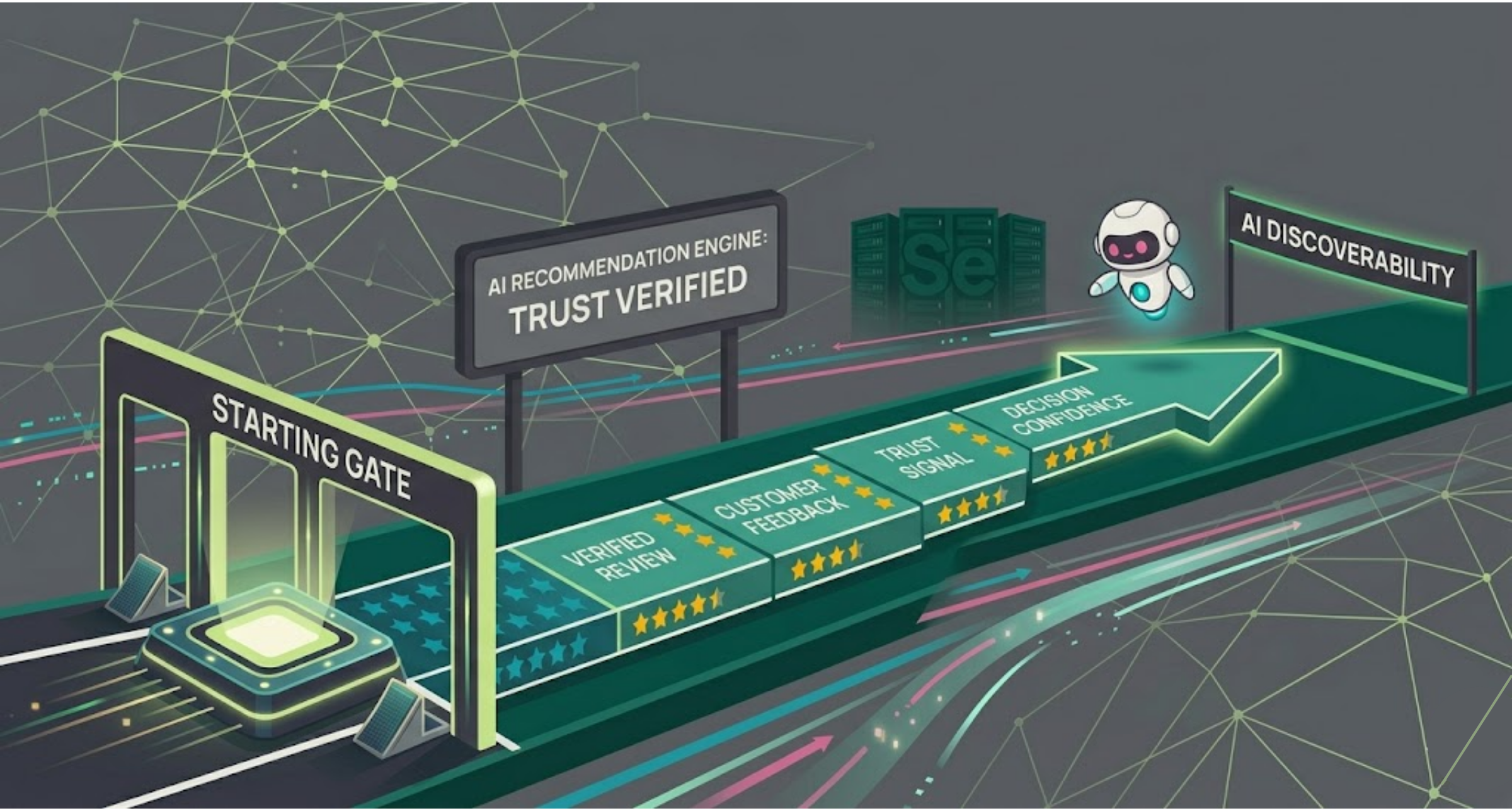
Preparing your website and entire digital footprint for the era of AI search is exactly like a racehorse about to jump out of the stalls.
Branding, messaging, and consistency, alongside technical elements like website code, schema, and loading speed, act as the starting mechanism. If your data is not structured in a way that AI models (like ChatGPT, Gemini, or Meta AI) can easily read, the horse will simply limp out at the start and the race happens with you trailing behind and unlikely to catch up.
But once you are out into the race, your speed and endurance are dictated by one thing: Trust.
Traditional search engines used to give users a list of links and left the user to figure out which one was best. AI engines do not do that. They act like highly cautious personal assistants. They prefer to give one or two definitive answers. An AI will try to avoid risking its reputation by recommending your business unless it has absolute decision confidence.
That is why your customer reviews are a core fuel for that confidence and why you need a strategy to capture them.
The AI Verification Process
When an AI suggests Company X as the best solution for a user's problem, it is because two vital pieces of information aligned. First, the company website clearly stated they solve the problem. Second, trusted, verified second-party sources confirmed it.
AI models seek out social proof on platforms like G2, TripAdvisor, TrustPilot, Capterra, and niche industry sites to ensure a brand's claims match public reality. If your website says you offer the fastest turnaround times in Ireland, the AI immediately cross-references external review sites. If the story matches, its decision confidence spikes. If you only exist on your own website, you are just an unverified database entry.
The Algorithm Has a Bigger Mouth
Word of mouth has always been the best way to build a business. But algorithms have a bigger mouth, and they are the most noisy entities alive.
They are scouring every nook and cranny of the internet in real time. They are not just reading formal review sites. They are scraping Reddit threads, niche forums, and social channels. Keep in mind that Google pays $60 million a year to license Reddit data specifically to train its AI on authentic human conversations. If people are talking about your brand, the algorithm hears it.
Strategy: Recency and Context Beat Empty Stars
You cannot just rely on organic reviews. You need a comprehensive strategy. How do you incentivise feedback? At what point in the customer journey do you ask for it?
When I tackle this for clients, we map the entire customer journey to find the exact "moment of joy", the point of highest satisfaction to trigger the review request. In a recent campaign, we doubled the reviews of a business that is now a category leader.
But we cannot rest. Here is why:
- The Algorithm Craves Recency: AI focuses heavily on fresh data to understand current sentiment. A flurry of reviews from 2024 will not help you in 2026.
- Words Matter More Than Stars: An empty five-star review is virtually useless to an AI. Large Language Models process text. A four-star review that explicitly mentions a specific pain point you solved creates a semantic map that the AI can match directly to a future user's highly specific prompt.
The Crackdown on Fakes
If you think you can fake this, think again. The platforms are fighting back aggressively.
Google’s latest updates heavily deploy machine learning to spot unnatural review spikes and purge incentivised or manipulated feedback. Legally, the risks are immense. In the US, the FTC’s recent rules allow for massive fines per fake review violation. Closer to home, the UK's Digital Markets, Competition and Consumers Act has made fake reviews a banned practice, with the CMA able to impose fines of up to 10% of global turnover.
You need real strategies for real reviews. At its core, that means building a great business, doing things the right way, keeping clients happy, and finding a way to capture that happy customer in the right way.
The Unsolved Dilemma: What If Your Clients Need Anonymity?
This brings me to a conversation I had recently with an excellent business consultant. He has an incredible body of work helping distressed businesses, but he faces a wall. His clients demand absolute anonymity. No CEO in Ireland wants to publicly admit their business was failing and they needed help.
The same applies to psychologists, executive coaches, and private medical clinics.
You can put anonymous testimonials on your website all day long ("John D., Saved my business!"), but as we established, AI is deeply sceptical of unverified, self-published claims. It needs proof. So, how do we prove to AI that these businesses are doing great work when their happy legion of customers refuses to speak publicly?
I actually do not have the perfect answer for this yet. I am actively working through this process. Out of curiosity, I asked an AI (Gemini) how it evaluates these types of businesses, and it gave me three technical workarounds:
- Platform-Verified Anonymity: Using high-tier B2B platforms like Clutch where the platform interviews the client and verifies the contract, but publishes the review anonymously. The AI trusts the platform's verification process.
- Knowledge as Proxy for Trust (E-E-A-T): If an AI cannot find reviews, it looks for profound expertise. Deep, anonymised case studies detailing the exact methodology, metrics, and outcomes signal high authority.
- Digital PR: When clients cannot vouch for you, industry peers and trusted publications must. Quotes in the Irish Times or industry journals pass domain authority to the consultant.
While the AI's answer makes technical sense, operationally, it is a massive hurdle for small practices.
How are you handling this? If you run a business dealing with sensitive client issues, how are you generating the external social proof required in 2026?
Final Thought
I would love to hear your thoughts on my LinkedIn as we figure this new landscape out.
Would you like AiSe to run an "AI Ready Audit" on your business? We'll show you exactly what Claude, ChatGPT, and Gemini can see about your business and how likely they are to choose you from your competitors
Book a Free Consultation
Want to learn how to get your business ready for Ai Search?

Kevin Breslin
Kevin Breslin, founder and lead consultant, brings 15+ years of experience across marketing, media, content strategy and digital transformation. He’s worked across sectors from e-commerce, hospitality to SaaS helping businesses grow by staying ahead of where attention is going. Now, his focus is clear: helping businesses show up in AI search. Not with hype. Not with guesswork. But with structured, strategic action rooted in real understanding of how people find information today. Kevin works alongside a trusted network of advisors, researchers, content specialists to bring clients smart, focused results without fluff.